This is my first ever battle report/review of a board game.
Last night the Phillip Island Gaming Society took a change from tradition and played a new board game that “magically” appeared in Buckos letter box. Being a Plains Indian Wars fanatic it was of course Custers Last Stand. Our rule is if you are the host you choose the game and so we waited with bated breath as Bucko ranted on about the rules and gave us a history lesson to boot. Yeah yeah we know……… the Indians won.
Immortalised on the Silver Screen by the movie “They died with their boots on”, the Battle of the Little Big Horn provided fame to a man who up to that point in time, was otherwise, a rather banal Union Cavalry General. Albeit one with overt political aspirations.

“Major General George Armstrong Custer. 23 year old General, Bold Cavalry Commander, and Hero of the Civil War. Wild, Unpredictable, Ambitious. Fast forward 11 years: Suspended, Reduced in rank, returning to command the 7th Cavalry in one more battle, potential presidential candidate. Looking for a fight and a return to glory.
Sitting Bull, Crazy Horse, and the Sioux nation will give him his fight, and in some ways his glory”…. from the advertising blurb of:

This is an old school hex and counter war game from Worthington Publishing that includes 2 full complete games in one box. Both game maps are hard mounted, front and back on one large game board. Both are playable in under two hours. Both are for 2 players but are solitaire friendly. Both are complete games unto themselves yet use the same basic rule system. Everyone knows about the Little Big Horn battle. The battle of Rosebud Creek was its prelude, just as big, and may have prevented troopers from reaching Custer.
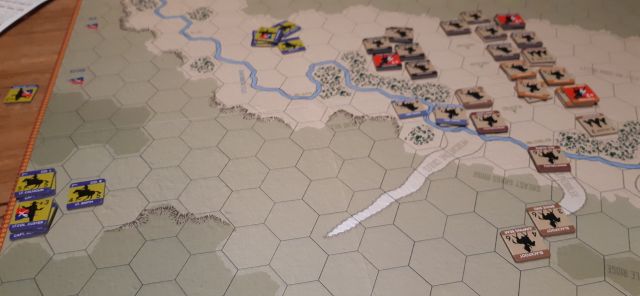
Reno’s cavalry move towards the Indian camps at the top left and Custer’s contingent enter the battle on the bottom left.

Reno has engaged the Indian warriors, whilst Custer is approaching “last stand hill”, on his way to cutting off the fleeing women and children. Cheyenne warriors are about to cross the Little Big Horn river to intercept.

Custer breaks through the Cheyenne on the way to complete his out-flanking move.
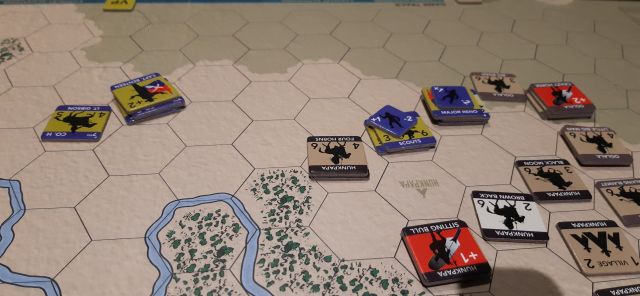
Bentine is coming up to support Reno, who has dismounted (blue markers) in the face of Indian attacks. It was at this stage that the Reno player was heard to make a very politically incorrect statement about wanting to attack the Indian villages rather than their warriors, that for reasons of common decency will not be repeated here.
We also made the same act in character by taking a sip from his glass of Cabernet Sauvignon before each of his moves. Hardly a swig of whisky from a hip flask but we improvised as best we could. I had to keep an eye on this as he was my ride home!
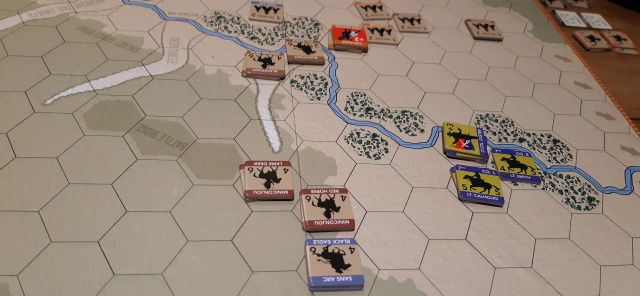
Having dispersed the Cheyenne and causing their chief “Two Moons” to retreat, Custer is about to cross the Little Big Horn and threaten the fleeing Indian Villagers. It was now turn ten and the 7th Cavalry had reached the trigger point of 13 Victory Points to end the game.
How did this differ from the “real” battle? The major difference was that Custer did not split his forces along last stand hill. He also did not stop waiting for Bentine’s arrival, but kept on with his original plan of getting behind the fleeing villages. His concentration of forces made it fairly easy to deal with Two Moon’s Cheyenne blocking force. Reno dismounted to fight and was able to hold off the Indian tribes starting to surround him. Most of Reno’s losses in the real battle were in the mounted retreat back to Reno Hill.
In addition Bentine decided to ignore his conflicting orders from Custer and move towards the sounds of gunfire near the Indian village. In otherwords gamers who know their history generally do not make the same historical mistakes.
The First Nations tribes are activated each turn in a random manner, making it difficult for the Indian player to coordinate attacks. Also another game mechanic (I assume for play balance) does not allow the Indians of one tribe to support those of another.
An owl, or several, must have passed over the Indian encampment the night before the battles as Bucko (as normal) had no luck with dice rolling or which tribes were activated. He continually had the smaller tribes activate making it difficult to launch a major attack.
As a game “Custers Last Stand” was great fun to play, it was historical enough to get the feel of re-fighting the Little Big Horn, but the changes required to make the game balanced took something away from history. Saying that who wants to play a game that is so one-sided it is no fun – NOT me. As Custer, I felt I couldn’t lose – I either died an ignomous death on Last Stand Hill and achieved immortality, or achieved a glorious victory, ran for the Presidency, succeded and was assasinated by a First Nations Baltimore failed actor.
*The first line of the Irish Jig “Garryowen” which was the marching song of the 7th Cavalry.
The word garryowen is derived from the Irish proper name Eóin and the word for garden garrai – thus “Eóin’s Garden.
Irish literature records “Owen’s garden was a general rendezvous for those who sought simple pleasure and amusement. The elderly drank together under the shade of trees and the young played at ball, goal, or other athletic activities on the green; while a few lingered in the near-by hedge-rows with their fair acquaintances”.
As a marching cadence it has become, to Native Americans what, “Deutschland Uber Alles” is to Jews, a hated reminder of the evil past.
It was played at the battle of the Washita in Western Oklahoma in 1868 where Custer and 700 men of the 7th Cavalry crept up on an unsuspecting native American village and played “Garryowen” to signal the start of the battle before plunging into the village and destroying everything and everybody around them. Up to 100 men, women, and children were massacred.
The song is now banned.
Sounds like you enjoyed the game! 🙂 Enjoyed the report!
Custer and I are members of The Long Gray Line! I actually came across his gravesite at West Point on a jog – was interesting. He of course graduated last in his class, but was a reasonably good leader of cavalry in the Civil War.