
During the Mahdist War (1881-1899), Indian cavalry regiments, part of the British Indian Army, played a significant role in the British and Egyptian efforts to suppress the Mahdist rebellion in Sudan, particularly in the pivotal 1898 campaign and the historic Battle of Omdurman.

These regiments, composed of skilled horsemen from various regions of India, were instrumental not only due to their combat capabilities but also because of their ability to adapt to the harsh conditions of the Sudanese terrain.

Their involvement was marked by bravery and tactical proficiency, showcasing the unique contributions of the Indian troops within the larger colonial military framework.

The campaign culminated in the decisive victory at Omdurman, where the cavalry showcased their exceptional mobility and effectiveness in battle, establishing a legacy that would be remembered in both British military history and the broader narrative of India’s role in imperial conflicts.

The figures are the HaT set 8289
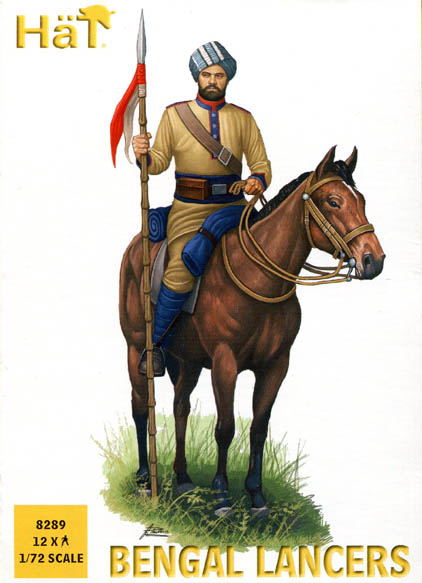
I think they are one of their better sets, with the uniform correct, including the “Lungi” which is wrapped around a pointed cap called a “Kulla’. Although named for Bengal, by no means all the troopers were actually Bengali, and while their main uniform was common to the whole regiment, the form of headdress varied between squadrons, depending upon their religious or tribal background.

With the additional right hand arm options the set is very versatile, I like them


Tomorrow some more infantry.
Nicely done, Dave! 🙂 I have a feeling the lance pennon can also be different colours for different regiments – the figures I painted that I thought I’d done as Bengal Lancers turned out to be Bombay Lancers!