Abwehr Agent

The Abwehr was a German military intelligence (information gathering) organization from 1921 to 1944
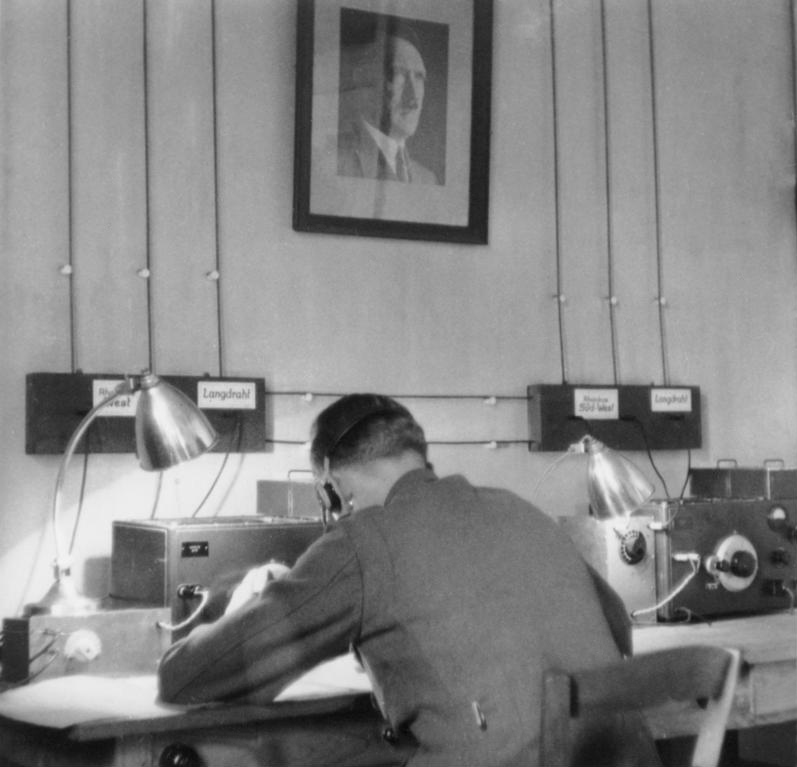
Bundesarchiv Bild 146-2005-0157, Geheimer Funkmeldedienst des OKW

The term Abwehr, meaning German for defence, was used as a concession to Allied demands that Germany’s post–World War I intelligence activities be for “defensive” purposes only.

After 4 February 1938, its name in title was Foreign Affairs/Defence Office of the Armed Forces High Command (Amt Ausland/Abwehr im Oberkommando der Wehrmacht).

Despite its name implying counterespionage, the Abwehr was an intelligence-gathering agency and dealt exclusively with human intelligence, especially raw intelligence reports from field agents and other sources.

The Chief of the Abwehr reported directly to the High Command of the Armed Forces (Oberkommando der Wehrmacht, or OKW).

Intelligence summaries and intelligence dissemination were the prerogative of the Operations Branch (as distinct from the Intelligence Branch) of the OKW, and through it to the intelligence-evaluation sections of the Army (Heer), the Navy (Kriegsmarine), and the Air Force (Luftwaffe).

The headquarters (HQ) of the Abwehr were located at 76/78 Tirpitzufer, Berlin, adjacent to the offices of the OKW.

The information in this post was obtained from the Military Wiki.

“The Battle of the Bismark Sea” by Michael Veitch

This is another fine air force history by Michael Veitch. The Battle of the Bismark sea would be the most one-side battle of the entire war and one that the Japanese would never recover from.

The battle immediately convinced the Japanese that they could not operate even strongly escorted convoys in areas within range of land-based Allied air planes. From then on, they were forced to rely on barges, small coastal vessels, and submarines to provide a lifeline to their vital strategic outposts in the archipelago.

Aerial attacks continued to exact a dreadful price on Japanese ships, even as they hugged the coasts in desperate attempts to escape detection from above. Submarines met with more success but could not move significant quantities of men and materiel.

The battle was to take a vicious turn when several Zeros broke of from attacking American bombers to shoot the parachuting survivors of an American B52. Radio silence was broken as the American airmen were aghast at what they just saw.

From then on NO quarter was given with Japanese soldiers and sailors being strafed in the water, and life boats and landing barges being sunk.

Throughout the next day the same “mopping up” occurred.

In the thick of World War II, during the first week of March 1943, Japan made a final, desperate lunge for control of the South West Pacific. In the ensuing Battle of the Bismarck Sea, a force of land-based Australian and American planes attacked a massive convoy of Japanese warships. The odds were against them. But a devastating victory was won and Japan’s hopes of regaining the initiative in New Guinea destroyed.” From the publisher.

All eight transport and cargo ships were sunk with the 6,000 troops destined for Lae for an attack on Port Moresby. Four of the eight escorting destroyers were also sunk. Destroyers rescued 800 men and transported them to Lae and then returned with submarines to fill the crowded decks with more survivors for the long trip back to Rabaul

More importantly for Australians, the victory decisively removed any possibility that Australia might be invaded by Japanese forces. It was, for us, along with the Battle of the Coral Sea, one of the most significant times in our history – a week when our future was profoundly in the balance.

Rating: 3.5 out of 5.

A great read about the battle, the oreparation, and the new attack methodology used.

Commando Comics

I use to love “Commando Comics” growing up (they first appeared when I was eight) and although I have picked up the odd second hand copy here and there I have not been a regular purchaser.

Recently I came across this site which was offering a very cheap on-line subscription. You receive 100 issues a year for AU$79.99 annual subscription, that’s AU$0.80 per comic. I subscribed a month ago and with my freebee for signing up I have already received these:

They are an excellent “primary source” material for designing scenarios and great value to boot!

A must for any fan!

Rating: 5 out of 5.

Beware of Geeks selling Greeks – don’t even peek!

I picked up a pile of WW2 Greeks on Gumtree the other day. Wasn’t really thinking of them as a purchase so I should not have gone looking in the first place! Oh well at least they were cheap.

When they arrived I was pleasantly surprised about how many of them there are.

In fact there are over 1600pts for Bolt Action.

The figures look like they are the Great Escape Mountain Infantry range.

There are two HQ packets.

Three Infantry squads

Three more squads for a total of six 11 man squads

Medium mortar

Sniper – this is a great little set.

Greek Orthodox chaplains which I really like.

Forward observer team

Flamethrower, although not allowed in the list.

Light field gun

Anti-tank gun

Anti-tank rifle.

Light Infantry mortar

Looks like I may have to change some painting priorities!

“On our Doorstep” by Craig Collie

Craig Collie is the author of the highly acclaimed The Path of Infinite Sorrow and Nagasaki, as well as The Reporter and the Warlords and Code Breakers. He is a TV producer-director by background and was head of TV Production at SBS.

I can’t understand the mentality of the Australian people. One day they are in a panic about the war and the next they want more race meetings.’ – John Curtin PM

By March 1942, the Japanese had steamrolled through Malaya, laid siege to Singapore, and bombed Darwin with the same ferocity they had dealt Pearl Harbor. Nothing could stop them. Their next step was inevitable, surely: the invasion and occupation of Australia.

Meanwhile, as Australian prime minister John Curtin was battling with Winston Churchill to get troops back from overseas to defend their homeland, he was also positioning to ensure the United States would be there with us to fend off the approaching enemy.

And at home, people pitched in as best they could and in any way to frustrate the invader. They all played their part, torn between ‘she’ll be right’ and near panic.

On Our Doorstep is the story of how Australia and Australians – the government, the military and the people – prepared to face this calamity, and the events that persuaded them of its probability. In the end, Japan found it had stretched itself beyond the reliability of its supply line, but had it ever intended to invade Australia?

The evidence is far from certain but it is unlikely.

General Sydney Rowell

General Sydney Rowell was once asked “What would Australia’s response be if the Japanese landed at Broome and headed for Alice Springs?”. He replied, “Send out the Salvage Corps to pick up their bones”!

There is an interesting discussion on the politics of the “Brisbane Line” where allegations within the Australian Labour Party of a preparedness to fall back to Brisbane should an invasion occur. The “Brisbane line” was an alleged plan to abandon Northern Australia in the event of a Japanese invasion.This incensed Queensland labour party members whose electorates would be left undefended. That it was a military contingency plan is probably true but more than that is doubtful.

Another interesting discussion around the “scorched earth policy” and its preparations. A more detailed account of this can be found in Sue Rosen’s book “Scorched earth” which I will post on kin the near future.

The book was an interesting read that put some of the discussions with my Mother and Grandfather into context. I don’t necessarily agree with all of Collie’s conclusions, which was a similar comment I made on his book “The Path of Infinite Sorrow”. There are better books around.

Rating: 2 out of 5.

Aliens in all their gory!

These are the “Aliens” from the boxed game that I have painted up.

They were extremely quick to paint. A rattle can undercoat of Tamiya TS3, splashed on nurgle shade, a blue wash, then dry brushed lightly with a very bright lime green.

They were then sprayed with a clear gloss acrylic to give a “wet” look.

I am quite pleased with the final look.

These were the pics I used for inspiration.

I will start on the crew soon.

Aliens – the Board Game

Aliens: Another Glorious Day in the Corps! is a co‑operative survival board game in which you and your team of specialist Colonial Marines will gear up with serious firepower and head into Hadley’s Hope to find survivors and answers. But you’re not alone. To survive, you’ll need to work together, keep your cool, and stay frosty to fight off relentless Xenomorph ambushes and get out of there alive.

Players can play up to six different missions, taking them into different areas from the Hadley’s Hope terraforming facility to the deep, dark recesses of an xenomorph nest. Aliens also offers an exciting campaign mode to play four of the missions linked together, so players will need to fight relentless xenomorph attacks and keep each other alive all the way to the end of the campaign. The remaining two missions are purely about survival, it’s kill or be killed. The players are dropped into the game with nothing more than a pistol. They will need to scavenge weapons and gear while hordes of Xenomorph aliens are trying to get at them. How long can you survive against the odds?” – description from the publisher

I have put together all of the models and will start painting them tomorrow.

For the alien warriors, there are 4 different body types (A-D), that come in two pieces. Each body type has 2 head options (#1: with jaw closed, #2: with jaw open, for A, C, D body, the inner jaw is visible). The heads come with part of their spine. Every tail and every arm is interchangable among the bodies. It looks like there are 2 tail variants (#1: longer, #2: S-shaped), and you get two pieces of each. The arms look either identical or very similar to each other. The arms do not have any connectors. When you build your models on a sprue, you’ll still have 4 extra heads with spines you can use as trophies.

I have not hyet had a chance to play the game but I have read the rules and had a really good look at all of the components. What I have seen I like. It seems like a cross between the old Aliens game from Leading Edge Games, Space Crusade, and Zombicide.

There have been several criticisms that with some scenarios the game starts to become unwinnable after 4 hero characters, as you draw an Alien reinforcement card for every hero every turn. With 6 heroes in the game, the aliens just swarm the board, killing everybody.

Others have complained that the game is very random. With some good rolls and draws, you can win the scenario easily, while at other times, the aliens will just crush the same team. Personally I like the randomness – hell their Aliens after all!

Looks well worth the investment.

Rating: 3 out of 5.

Brandenburgers

The Brandenburgers were members of the Brandenburg German special forces unit during World War II.

Originally the unit was formed by and operated as an extension of the military’s intelligence organisation, the Abwehr.

Members of this unit took part in seizing operationally important targets by way of sabotage and infiltration.  Being foreign German nationals who were convinced Nazi volunteers, constituent members had lived abroad and were proficient in foreign languages as well as being familiar with the way of life in the area of operations where they were deployed.

Some time ago I posted on these Nuns with “bad habits” that were the start of my Brandenburgers for Sea Lion and Very British Civil War. Well I have finally started working on the rest of the them.

Here are they second group of eight (after the Nuns). I will mix them up into various units when they are all done to give a more motley look.

I have three more Brandenburger Spähtrupp units, 4 Sabotage teams, A Lieutenants team and an Abewhr Agent (36 figures) at various stages of painting.

The Brandenburg Division was generally subordinated to the army groups in individual commands and operated throughout Eastern Europe, in southern Africa, Afghanistan, the Middle East and in the Caucasus.

In the later course of the war, parts of the special unit were used in the fight against partisans in Yugoslavia before the Division, in the last months of the war, was reclassified and merged into one of the Panzergrenadier divisions. It is alleged they committed various atrocities in the course of their operations.

In early August 1942, a Brandenburg unit of 62 Baltic and Sudeten Germans led by SS Sturmbannführer Adrian von Fölkersam  penetrated farther into enemy territory than any other German unit.

They had been ordered to seize and secure the vital Maikop oilfields. Disguised as NKVD men, and driving Soviet trucks, Fölkersam’s unit passed through the Soviet front lines and moved deep into hostile territory.

The Brandenburgers ran into a large group of Red Army soldiers fleeing from the front. Fölkersam saw an opportunity to use them to the unit’s advantage.

By persuading them to return to the Soviet cause, he was able to join with them and move almost at will through the Soviet lines   Adrian von Fölkersam was killed in action on 21 January 1945, age 30 near Inowrocław.

I have a mixture of civilian types, Fallschirmjaeger, Panzer Grenadiers, British Paras, and British Tommies to give a totally mixed look. They will be painted in non-uniform colours to make them look more “spy-like”!

More coming soon.

The Architect of Kokoda – Bert Kienzle – The Man Who Made The Kokoda Trail

The first thing you will note is that the book title refers to the Kokoda Trail and not track! This has been an ongoing debate for years. The Papua New Guinea Government has gazetted it a trail, and it was known as the “mail trail” before the war and this is what Bert Kienzle knew it as.

I do know however, from my own grandfather, that it was known “as that bloody track”!

The Kokoda story continues to have a very powerful resonance with all Australians, and Bert Kienzle’s vital role is acknowledged in all the published accounts – but until now no one has ever told his story.

If one person ‘made’ the Kokoda Track, that man was Bert Kienzle. Part Samoan and German/English, born in Fiji and raised in Germany and Australia, he was managing a rubber plantation and gold mine in New Guinea at the outbreak of World War II. He surveyed and established the Track, and spent more time on it than anyone else throughout the campaign – managing and organising the delivery of supplies and men along it.

THE ARCHITECT OF KOKODA is a unique account of a very special part of our history, told by his daughter-in-law with unique access to the central character, and access to all his records and photos. This is the untold story of a true Australian war hero.“From the Publisher.

All of the histories on the Kokoda story mention the indebtedness of the “Diggers” to the work of Bert Kienzle, and his organisation of the native porters who supplied them. This is not a story of the battlefields, but one about the man himself, written from his dispatches, diaries. and endless notes. You receive an understanding of a remarkable and unique insight into a truly great man.

Thoroughly recommend it.

I read all 338 pages today – I just couldn’t put it down.

Rating: 4.5 out of 5.

Silver Bayonet Scenario 7

Last night we had a great game of Silver Bayonet between Will’s British, Wayne’s Prussians and Guru’s French heroes.

French volley fire

We played Scenario 7 which is a shoot-out in a farm with some bandits one of whom is a Changeling – but which one.

The French take first blood as one bandit bites the dust. Alas he was not the changeling.

It is hard to tell who was more dangerous the goats or the Prussians.

The tabletop

French try to take out more bandits.

The French officer takes out another bandit, but not the changeling.

The Prussians take out another bandit.

The French officer takes out his second bandit

Firing both pistols.

Hold still you ass!

Now down to just two bandits hiding in the farmhouse

The British kill the seventh bandit who was the changeling!

Abdul kills the changeling who promptly turns into the Book of Cain that we have been searching for.

The French Sergeant goes down to bandit fire.

The French Occultist, Neb Nefer, takes out the last bandit and has the Book of Cain almost in his grasp!

Abdul quickly dispatches Neb Nefer with his trusty blade – thwarting French plans.

The Prussian Grenadier sneaks in behind Abdul and snatches the Book of Cain (the werewolf model).

After several melees, and falls back, the Prussian Grenadier makes a run for home with the book!

Prussian compatriots attempt to protect the book and its carrier.

More Prussians go down.

A long range British shot takes out the Grenadier, leaving the book on the ground.

Abdul is shot by the Doctor with surgical precision.

Yum!

Carnage in the farmhouse home paddock as the Prussians escape with the book.

Birnam Wood travels to Guru

A great game was had by all.

Of those downed during the fight a British and a Prussian soldier were killed and a Frenchman and an Englishman received permanent injuries. The French Caporal Jules Leger will now have to be invalided out with permanent injuries to his left leg, right arm and now has the “shakes” as well!

If you haven’t tried Silver Bayonet you really should!