Brethren Skirmish rules – a review.

Imagine a skirmish system so fast and exciting that even a cheetah would take notes! Brethren is all about being Fast, Fun, and Ferocious—it’s like a rollercoaster of chaos where you can dive in without needing a PhD in game mechanics. Whether you’re a fresh recruit or a battle-hardened veteran, you’ll find that the rules are simpler than your toddler’s bedtime story, making it easy to jump right into the action. Get ready for a wild ride where strategies change faster than you can say “gotcha!” With each clash, your adrenaline will spike as teams go head-to-head, ensuring that every moment is more enjoyable than finding an extra fry at the bottom of the bag!

The rules are cleverly crafted to make wargaming possible for the busy bees among us—students, professionals, and parents who are basically juggling flaming swords while riding a unicycle. Coordinating games can feel like trying to herd cats while managing work and personal chaos, and let’s be honest, that’s about as fun as a trip to the DMV. Enter Brethren, the superhero of tabletop games, swooping in to save the day by simplifying setup and gameplay, allowing battles that feel epic without sending you into a stress spiral. With flexible timeframes and mechanics that adapt like a chameleon at a party, Brethren fits into your schedule tighter than your skinny jeans after the holidays, creating a delightful community for those just trying to survive the week. This game is the answer for all us passionate players craving some fun amid the delightful madness of life. Perfect for a mid-week escape from reality!
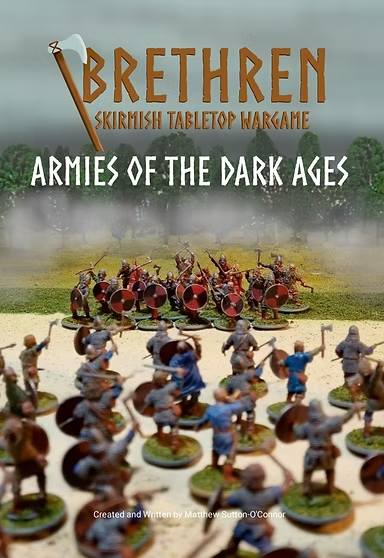
This flexibility makes Brethren an ideal choice for both casual players looking for a rapid battle and dedicated gamers eager to explore deeper tactics in a fuller session, making it not just a game, but a versatile tool for enjoyment that can adapt to any player’s needs or schedules.
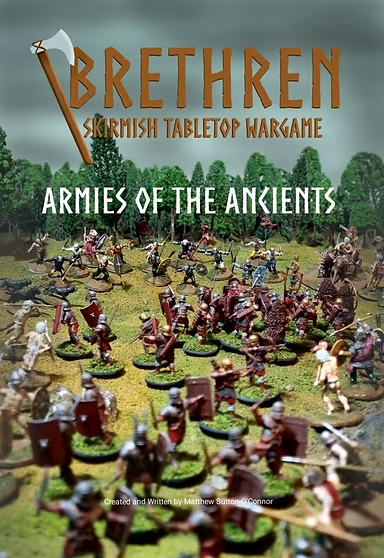
The rules are broken up into distinct phases:

The Priority Phase

During the Priority Phase players dice to see who activates one of their units (figures) first. Activation is determined each turn, not once for the game.

The Activation Phase

During the Activation Phase you choose a figure to move and complete all of its actions, Generally this is two, but some types of units have more activations.

A number of actions can be used these include:

  • Move up to the move distance on the units description (one action point);
  • Run – normal distance +D6 inches (two action points);
  • Wait – in effect do nothing (one action point);
  • Prepare – for close combat (one action point);
  • Aim – prior to shooting (one action point);
  • Loose – shoot (one action point);

No unit may use an action other than Wait twice in the same activation.

Close combat is initiated when units are in contact, and there are special rules for charges that fall short – in essence you any is more prepared and your fighting ability is diminished slightly.

When all units are activated the turn has ended.

The terrain rules are practical and feature a detailed 3D approach with guidelines for height advantage, ladders, and other factors affecting gameplay. This system enhances realism and deepens strategy, allowing players to creatively use the terrain, like having an archer climb a tree for better visibility in combat. It encourages critical thinking about positioning and exploring tactics, leading to more engaging gameplay. Using landscape elements makes the game enjoyable and offers opportunities for innovative strategies that can influence battle outcomes.

The game features sieges, adding strategic depth not often seen in rule sets, enhancing battle storytelling and historical understanding. A recruitment system allows you to equip figures with various choices, creating personalized armies that fit your tactical style. Each army has strengths and weaknesses that influence battle outcomes while maintaining balance. The mechanics ensure a fair environment where strategy is key, encouraging players to explore different tactics and enrich their experience.

The main difference from other rules lies in the unique Heroes Activation Phase, which adds an exciting strategic element to gameplay. During this phase, a hero can choose to activate as a single unit, utilizing their three distinct activations to perform various actions. Alternatively, they have the option to move any other unit located within a six-inch range, provided that this unit has not already activated during the current turn. This flexibility allows players to carefully plan their moves, either maximizing the hero’s own actions or supporting other units on the battlefield that may require timely repositioning or engagement.

I am a big fan of these rules.

Rating: 4.5 out of 5.

Brethren Battle Report 4 February 2025

Oops just noticed this unfinished battle report dating way back to February.

Wayne and I decided to have a game of “Brethren” a reasonably new set of Dark Age Skirmish rules.

A huscarl supporting my shieldwall is taken out by Wane’s long range bow fire

Next I lost one of my archers who was skirmishing in frontof my shieldwall.

Things were going from bad to worse as I lost another warrior who was supporting a huscarl.

Throwing caution to the wind the huscarl charged the end of the darstardly invaders shieldwall and took out their first casualty.

Another one of my warriors was downed by bow fire.

My huscarl was gradually taking out the invaders warriors one by one, as an opposing warrior tries to outflank him on the hill.

My general is attacked and promptly dispatches the would be giant killer.

The last of the enemy shieldwall is dealth with.

The battle had very quickly swung in my favour when all looked lost early. The enemy leader is dealt with sealing the invaders fate.

Brethren is very much like that. A single heroic event (code for good dice rolling) can cause chaos in your opponents rnks and turn the tide quickly. Make no mistake this was a game where I grabbed victory from the jaws of defeat. Wayne was as unlucky as I was lucky.

I really like this game even when I lose!

Anglo Saxon Army for Brethren Skirmish Rules

With figure already painted and needing just re-basing I have been able to build up the Anglo Saxon army for Brethren Skirmish.

The whole contingent with most options.

5 Armoured Thegns with Shield

Mounted Hero with Danish Axe

5 Huscarls with Danish Axe

Monk (Support Hero)with mace

5 unarmoured Fyrd with Spear

5 Unarmoured Fyrd archers

I hope to see these soon in battle.

Battle Report for Game of Brethren 17 Dec 2024

This game between the dastardly Vikings of Wayne and Drew and the mighty Irish of Guru went right down to the wire or indeed the last die roll of the game.

Irish move forward to take the wagons

In fact the game was so enthralling I forgot to take photos, and no it is not because I am a septuagenarian!

The battle wears on with the Viking in charge of one wagon, the Irish with none.

Viking archers causing chaos from behind cover……..sniveling cowards!

The game at the end. The Irish Hero has just charged and defeated a Viking Raider and allowed his archer to take control of the wagon full of Guinness – thank you Aengus Óg! The three Vikings in the centre only hold the wagon on the left.

A second wagon is held by an Irish noble

Another great game of brethren. If you haven’t tried it you really must give it a go.

Irish Revenge outside Veðrafjǫrðr

The name ‘Waterford’ comes from Old Norse Veðrafjǫrðr ‘ram (wether) fjord’. The Irish name is Port Láirge, meaning “Lárag’s port”. Viking raiders first established a settlement near Waterford in 853.

Donagh Ó Connacháin

Having been informed of a Viking supply train heading into Veðrafjǫrðr, ceann cine (clan leader) Donagh Ó Connacháin decided it was time for revenge on the Norse usurpers, who had long pillaged his lands and oppressed his people. With a determined heart and a fierce desire to reclaim his family’s honour, he called upon his loyal warriors to gather under the cover of darkness.

Veðrafjǫrðr in Viking times

Together, they meticulously planned an ambush, strategically positioning themselves along the path the supply train would take. As the sun dipped below the horizon, casting eerie shadows through the thick forest, the tension tightened among the men, each one eager for the moment they could confront their foes and restore their people’s pride.

Initially, the raid went well with one wagon having been captured, its contents rich with supplies and treasures of significant value. However, as the raiders reveled in their early success, things took a decidedly down-hill turn when an Irish noble, fueled by a fierce desire to defend his homeland, charged at Olaf the archer, who was soon to be named the Giant Slayer for his imposing stature and relentless bravery. This noble, confident in his ability to turn the tide of battle, galloped forward with his sword raised high, only to be abruptly halted when an arrow, unexpectedly swift and deadly, struck him squarely between the eyes before he even reached halfway to his target. The shock of the moment echoed through the ranks, transforming what began as a promising raid into a chaotic struggle for survival, as the remaining defenders scrambled to adapt to the sudden turn of events.

Revenge was swift as a Viking archer was pierced by Irish justice.

The Viking shield wall, steadfast and imposing, advanced with their leader cowering in the midst, as they “bravely” charged an Irish kern. This fierce warrior, although pushed backwards by the daunting odds of four to one, stood resolutely in defiance, showcasing incredible courage against the usurpers. With each step, the clash of shields echoed through the air, and the tension mounted, for the Irish kern knew that surrender was not an option; his heart burned with the fire of his ancestors as he prepared to fight for his homeland, determined to hold his ground despite the overwhelming assault.

With one wagon captured the Irish spearmen now turn to face the Viking shield wall.

The Viking archery counter-fire was devastating, its rapid volley of arrows raining down upon the battlefield with deadly precision as two of the brave Irish archers were wounded, falling to the ground amidst the chaos. The air thickened with the sounds of steel clashing and the cries of warriors, each moment stretched by the tension of the struggle, while those remaining on the Irish flank fought valiantly to protect their comrades, unwilling to succumb to the relentless assault.

The Viking shield wall launched a ferocious assault against the Irish kerns, their battle cries echoing across the battlefield as the clash of steel rang in the air. In the midst of this chaotic engagement, the “brave” Viking leader fought timidly, and was the only one to falter amidst the fray, his sword faltering when it mattered most. Despite his moment of weakness, the Viking forces remained resolute, and their fierce determination resulted in the loss of only two more Irish raiders, showcasing the relentless intensity of the encounter and the valor displayed by both sides as they fought for their honour and land.

The Irish morale stood firm as Donagh Ó Connacháin was recalled to witness the birth of his son and heir, a moment that filled his heart with both pride and trepidation. As he journeyed back to his homeland, thoughts of legacy and duty swirled in his mind, each step representing the hopes of his ancestors and the future of his lineage. Family and friends gathered in anticipation, their faces a mix of joy and concern, knowing that this new life symbolized resilience amidst the challenges they faced. The air was thick with the scent of earth and the sounds of celebration, as songs of old were sung in honor of the new arrival, reinforcing the bonds that held their community together.

The Irish still fought on bravely with Olaf being charged by the Irish “wolf-skin”, a fierce and formidable warrior known for his unmatched bravery in battle and his ferocious loyalty to his kin. As the chaos of the skirmish enveloped them, history repeated itself as Olaf drew his bowstring taut, his muscles tensing with the strain, and another valiant noble, caught in the fierceness of the fray, was wounded by a well-aimed shot that seemed to echo the tales of old where fate determined the fall of men. The cries of valour and the clash of swords resonated through the air, mingling with the shouts of warriors as the Irish warriors fought with unwavering spirit against overwhelming odds, determined to secure their legacy and honour.

In desperation, Olaf was charged by an Irish archer, whose fierce determination was matched only by his skill with the bow. The archer drew back his string with great precision, aiming intently, but despite his usual accuracy, he missed for the first time that fateful day. Seizing this opportunity, Olaf summoned all his strength and courage, swiftly countering with a well-aimed strike that dispatched the unfortunate Irishman to the mythical realms of Tír na mBeo, a place said to be filled with eternal beauty and the whispers of those who had fallen in battle. The air crackled with tension as onlookers held their breath, witnessing the dramatic turn of events where hope and despair intertwined in that moment.

The lone Irish archer stood bravely before he also was summoned to his ceann cine’s celebratory feast in honour of his newborn son, a joyous occasion that brought together friends, family, and fellow warriors from far and wide, each eager to share in the festivities that would mark the beginning of a new life and the continuation of their noble lineage.

As the sun dipped below the horizon, casting a warm golden light over the gathering, laughter and song filled the air, creating an atmosphere rich with the scent of roasted meats and sweet pastries, while the archer, feeling a mix of pride and longing, held his bow tightly, ready to showcase his skill as a reminder of his loyalty and dedication to his kin.

The usurpers were taught a lesson that the Irish would never submit to the yoke of oppression, a resolve that ran deep in their veins and echoed through generations. Their fierce spirit, born from centuries of struggle and sacrifice, ignited a flame of resistance that could not be easily extinguished. Time and again, Donagh Ó Connacháin would stand united against tyranny, demonstrating that this rich heritage and unwavering pride made him a formidable opponent. This indomitable will sent a clear message to oppressors everywhere that the Irish clan leader was not a mere subject to be ruled, but a proud leader determined to reclaim his freedom and assert the clan’s rightful place in history.

Liam and I had a great game, with alas the above saga not really telling the true tale of the Irish debacle!