More titles from Guru Pig

The following sets of rules are now available on Wargames Vault

This rule set emphasizes the distinct asymmetric nature of the two armies, focusing on Roman discipline versus Gaulish individual prowess and numerical advantage.

It is designed to be a quick skirmish game with simple mechanics but also one in which tactical acumen is required. The figure scale is agnostic although I find the larger 54mm and 75mm scale figures work well and provide a larger visual spectacle.

As indicated above the game features an asymmetric conflict between the disciplined Roman forces and the fierce Gauls. Romans move on in column formation on a short table edge, and any casualties they take are permanent. The Gauls, however, stream onto the board from any long table edge and their casualties are not permanent; they can re-enter the game on the next turn, representing their vast numbers. Movement speeds reflect this difference: Gallic figures, including cavalry and chariots, move a full stick, while Roman infantry moves only a half stick.

The core of the game-play is the unpredictable Chaos of War activation system. The game utilises a deck containing one specific card for every unit on the board, plus a single Joker. Players shuffle this deck and draw cards sequentially. When a Unit Card is drawn, that unit immediately takes its single action (Move, Shoot, or Charge). The entire Activation Phase, and thus the opportunity for any remaining units to move, immediately ends if the Joker is drawn, forcing players to react constantly to the possibility of a sudden turn halt. There is no simultaneous movement phase, making the card draw the sole determinant of action.

Once the Activation Phase ends, either by the deck running out or the Joker being drawn, the turn has ended. There is no melee phase, combat occurs if at the end of a models activation they are in base to base combat with an opponent.. Combat uses a special skull/shield dice. The base number of dice rolled contrasts sharply: Gauls roll 3 dice, while Romans roll only 1 die. However, Romans gain crucial bonuses for formation, notably +1 die if their Signifier (standard bearer is present, and +1 die for every friend in base-to-base contact, rewarding tight, disciplined lines. Kills also favour the disciplined; a Gaul is removed by two uncancelled skulls, but a Roman requires three. Javelins are resolved only in melee, and the only long-range attack is the bow, which fires two dice at a range of two movement sticks.

This system creates a game where the Romans must leverage every bonus to survive the inevitable charge and hold the line, while the Gauls rely on their speed, high individual attack power, and the terrifying knowledge that their fallen warriors will soon return to the fray.

Welcome to Blade and Banner, the complete set of rules for intense, card-driven medieval skirmishes, for up to four players. This game plunges you into the gritty reality of small-scale combat, where individual skill, specialised equipment, and tactical positioning are the keys to victory.


Experience the visceral reality of medieval skirmish combat! Blade and Banner is a fast-paced, card-driven miniatures wargame that puts you in command of a small, elite retinue of knights, men-at-arms, and missile troops. Are you ready to seize the field?
The core of the game lies in its Card Resolution System. Every attack and defence is a high-stakes moment, using a unique card mechanic where specialised gear grants crucial card-draw bonuses (like the Lance’s +3 Draw on a Couched Charge) or imposes crippling save penalties (such as the Armour Cracker or Devastating Blow). This system provides genuine Tactical Depth as you equip your models with specialised load outs—from Accurate Longbows for ranged support to Great Weapons for heavy melee—each defining their role on the battlefield.

This package provides a Complete Skirmish Experience. It includes full Weapon and Resolution Tables, a ready-to-play Sample Retinue, and three distinct scenarios like The Bloody Ford and The Supply Train Ambush and the Joust to test your strategic skills immediately. Master the charge, outflank your foe, and secure your banner!


Welcome, welcome, citizens of the cosmos! Tonight, we find ourselves at the precipice! The abyss! Or, as I like to call it, ‘Tuesday’! But this is no ordinary Tuesday, my friends, because outside those very soundproofed walls—which, let’s be honest, were an absolute steal on an intergalactic clearance sale—a threat looms! The question is: which brand of spectacular, imminent destruction has punched its ticket for tonight’s show?” Will tonight’s doom be delivered by the legendary, the terrifying, the unbelievably messy… Ravaging Hordes!? Ah, the Hordes. They represent the purest form of chaos: mindless hunger. They don’t have a plan, they don’t have a spreadsheet, they just have an overwhelming, primal need to consume everything. Think of it like that time you owed your cousin, Zorp, forty credits, and then you just kept forgetting until the interest compounded into a self-aware, planet-devouring singularity. That’s the Hordes! They’re less ‘evil masterminds’ and more ‘a bad debt with teeth,’ and they move with the singular, unyielding purpose of a teenager trying to get to the last slice of pizza. They are here for one reason: to eat everything, including the microphone cable! The horde may include zombies, robots, bugs and insects or ectoplasmic constructs etc.


Or, will we face the sleek, the sinister, the truly over-prepared… Extinction Syndicate!? Now these guys? These are not your average slobbering monsters. Oh no. The Extinction Syndicate is organised, sentient, and frankly, kind of rude. They colour-code their atrocities! They have quarterly performance reviews for their lieutenants! They are the universe’s equivalent of that one neighbour who calls the Council because your hedge is 0.3 millimetres too high! And get this: rumour has it they’re not just packing heat; they’re probably packing lasers. Not just regular lasers, either—I’m talking about the ones that come with a little instruction manual and a three-year warranty! They’re not just trying to conquer the galaxy; they’re trying to do it with a five-step process and a professionally-designed PowerPoint presentation. Watch out, folks, because they are here to take over, and they expect you to sign a Non Disclosure Agreement first! So, buckle up, grab your existential dread, and let’s find out which brand of glorious cataclysm is about to ruin the buffet! The music… starts… NOW! The extinction Syndicate may include robots that just want to “exterminate”, grey aliens, and other organised nasties.

All three of these rules and “Tuk Tuk Zombie Rumble” will be available in print as an anthology from Amazon in the next few weeks.

Sword and Spear Fantasy

I enjoy playing Sword and Spear historical rules and am preparing figures for their fantasy version. I’ll start with my 15mm Vikings as Northern Barbarians. The current army lists let me include bears, Valkyries, mammoths, and giant eagles. Once I figure out the rules and points for them, I plan to add ogres, heavy chariots, a high priest/shaman in a wagon, a dragon, a pegasus, and some minotaurs.

“Sword & Spear Fantasy” is a tabletop miniatures wargame that adapts the core mechanics of the historical “Sword & Spear” ruleset to a fantasy setting. The has an elegant and engaging system, which prioritizes command and control over complex, chart-heavy rules.

The fantasy ruleset builds on this solid historical foundation, adding new mechanics to support the common tropes of fantasy wargaming while maintaining the game’s lauded fast and fluid pace.The most innovative and celebrated feature of the game is its activation system. Instead of a simple “I go, you go” turn structure, players roll a number of dice equal to their units and place them in a bag.

During each phase of the turn, dice are drawn from the bag, and the player who draws more dice becomes the “active player” for that phase. The number on each die determines which unit it can activate, with higher numbers allowing for better-quality units to perform more complex maneuvers or receive combat bonuses. This creates a sense of battlefield “friction” and forces players to make difficult command decisions, as you can’t always activate every unit every turn.

Combat is also praised for its simplicity, resolved with opposed dice rolls. Unit stats and weapon/armor types provide minor, but tactical, modifications, keeping the game flowing quickly while still providing depth.The fantasy additions are what truly distinguish this version. Magic is a significant inclusion, but it is implemented as a tactical tool rather than an all-powerful win button. Magic users can cast spells to boost friendly units, attack enemies, or protect allies, adding a flexible layer of strategic choice.

This is particularly critical for armies like the undead, which rely on magic to compensate for not getting the same benefits from activation dice as living troops.Furthermore, the fantasy rules introduce new unit types like “Heroes,” “Monsters,” “Swarms,” and “Flying Units.” Heroes and Monsters are dynamic battlefield tools rather than invincible juggernauts, while other creature types have their own unique abilities and drawbacks.

The game also includes special abilities such as regeneration, frenzy, and magical attacks, allowing for a wide range of army designs. A major point of praise is the game’s generic and flexible army lists, which allow players to create forces to fit any fantasy setting. This openness is seen as a major plus for creativity, although some reviewers caution that it can be exploited by players aiming for unbalanced, overly powerful armies.

Overall, “Sword & Spear Fantasy” is a well-regarded wargame that stands out for its unique command system and a focus on grand strategy over minutiae. It is highly recommended for players who want to stage large-scale fantasy battles that feel both heroic and tactically challenging, without getting bogged down in an overly complex ruleset. It’s often recommended for players who are looking for a historical wargame feel with a fantasy twist.

The rules look great and as they are based on the historical version I am sure will work well. I will hold on giving them a rating until I have played some games.

Some figures over the next few days.

Dinosaur terrain now complete

T-Rex trying to outrun the the erupting volcanos

Volcanoes, hills and forests.

The terrain is totally modular with lots of blank hexes for open ground.

One, two and three tier hills.

A water terrain piece made from three painted hexes.

The volcanoes close up

A water course using painted flat hexes.

Whilst not actually terrain there is the capacity for 3D aerial fights. Here Pterodactyls taken on a lone Dilophosaurus.

“Dangerous terrain”

The terrain is designed to be totally functional to fit the dinosaurs but to provide some aesthetics as well.

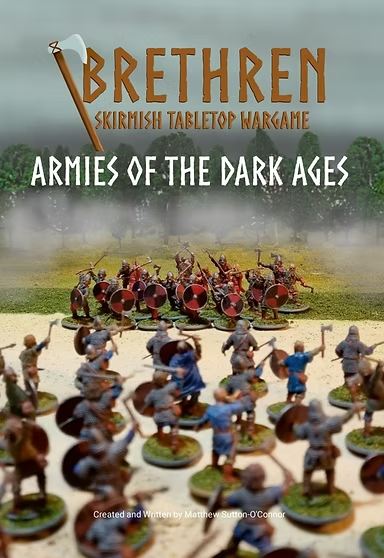
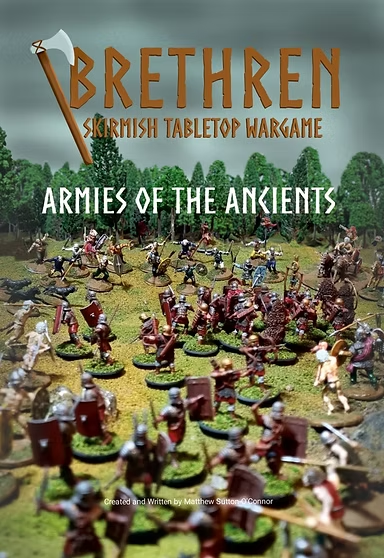
Brethren Skirmish rules – a review.

Imagine a skirmish system so fast and exciting that even a cheetah would take notes! Brethren is all about being Fast, Fun, and Ferocious—it’s like a rollercoaster of chaos where you can dive in without needing a PhD in game mechanics. Whether you’re a fresh recruit or a battle-hardened veteran, you’ll find that the rules are simpler than your toddler’s bedtime story, making it easy to jump right into the action. Get ready for a wild ride where strategies change faster than you can say “gotcha!” With each clash, your adrenaline will spike as teams go head-to-head, ensuring that every moment is more enjoyable than finding an extra fry at the bottom of the bag!

The rules are cleverly crafted to make wargaming possible for the busy bees among us—students, professionals, and parents who are basically juggling flaming swords while riding a unicycle. Coordinating games can feel like trying to herd cats while managing work and personal chaos, and let’s be honest, that’s about as fun as a trip to the DMV. Enter Brethren, the superhero of tabletop games, swooping in to save the day by simplifying setup and gameplay, allowing battles that feel epic without sending you into a stress spiral. With flexible timeframes and mechanics that adapt like a chameleon at a party, Brethren fits into your schedule tighter than your skinny jeans after the holidays, creating a delightful community for those just trying to survive the week. This game is the answer for all us passionate players craving some fun amid the delightful madness of life. Perfect for a mid-week escape from reality!

This flexibility makes Brethren an ideal choice for both casual players looking for a rapid battle and dedicated gamers eager to explore deeper tactics in a fuller session, making it not just a game, but a versatile tool for enjoyment that can adapt to any player’s needs or schedules.

The rules are broken up into distinct phases:

The Priority Phase

During the Priority Phase players dice to see who activates one of their units (figures) first. Activation is determined each turn, not once for the game.

The Activation Phase

During the Activation Phase you choose a figure to move and complete all of its actions, Generally this is two, but some types of units have more activations.

A number of actions can be used these include:

  • Move up to the move distance on the units description (one action point);
  • Run – normal distance +D6 inches (two action points);
  • Wait – in effect do nothing (one action point);
  • Prepare – for close combat (one action point);
  • Aim – prior to shooting (one action point);
  • Loose – shoot (one action point);

No unit may use an action other than Wait twice in the same activation.

Close combat is initiated when units are in contact, and there are special rules for charges that fall short – in essence you any is more prepared and your fighting ability is diminished slightly.

When all units are activated the turn has ended.

The terrain rules are practical and feature a detailed 3D approach with guidelines for height advantage, ladders, and other factors affecting gameplay. This system enhances realism and deepens strategy, allowing players to creatively use the terrain, like having an archer climb a tree for better visibility in combat. It encourages critical thinking about positioning and exploring tactics, leading to more engaging gameplay. Using landscape elements makes the game enjoyable and offers opportunities for innovative strategies that can influence battle outcomes.

The game features sieges, adding strategic depth not often seen in rule sets, enhancing battle storytelling and historical understanding. A recruitment system allows you to equip figures with various choices, creating personalized armies that fit your tactical style. Each army has strengths and weaknesses that influence battle outcomes while maintaining balance. The mechanics ensure a fair environment where strategy is key, encouraging players to explore different tactics and enrich their experience.

The main difference from other rules lies in the unique Heroes Activation Phase, which adds an exciting strategic element to gameplay. During this phase, a hero can choose to activate as a single unit, utilizing their three distinct activations to perform various actions. Alternatively, they have the option to move any other unit located within a six-inch range, provided that this unit has not already activated during the current turn. This flexibility allows players to carefully plan their moves, either maximizing the hero’s own actions or supporting other units on the battlefield that may require timely repositioning or engagement.

I am a big fan of these rules.

Rating: 4.5 out of 5.

Brethren Battle Report 4 February 2025

Oops just noticed this unfinished battle report dating way back to February.

Wayne and I decided to have a game of “Brethren” a reasonably new set of Dark Age Skirmish rules.

A huscarl supporting my shieldwall is taken out by Wane’s long range bow fire

Next I lost one of my archers who was skirmishing in frontof my shieldwall.

Things were going from bad to worse as I lost another warrior who was supporting a huscarl.

Throwing caution to the wind the huscarl charged the end of the darstardly invaders shieldwall and took out their first casualty.

Another one of my warriors was downed by bow fire.

My huscarl was gradually taking out the invaders warriors one by one, as an opposing warrior tries to outflank him on the hill.

My general is attacked and promptly dispatches the would be giant killer.

The last of the enemy shieldwall is dealth with.

The battle had very quickly swung in my favour when all looked lost early. The enemy leader is dealt with sealing the invaders fate.

Brethren is very much like that. A single heroic event (code for good dice rolling) can cause chaos in your opponents rnks and turn the tide quickly. Make no mistake this was a game where I grabbed victory from the jaws of defeat. Wayne was as unlucky as I was lucky.

I really like this game even when I lose!

Anglo Saxon Army for Brethren Skirmish Rules

With figure already painted and needing just re-basing I have been able to build up the Anglo Saxon army for Brethren Skirmish.

The whole contingent with most options.

5 Armoured Thegns with Shield

Mounted Hero with Danish Axe

5 Huscarls with Danish Axe

Monk (Support Hero)with mace

5 unarmoured Fyrd with Spear

5 Unarmoured Fyrd archers

I hope to see these soon in battle.

Battle Report for Game of Brethren 17 Dec 2024

This game between the dastardly Vikings of Wayne and Drew and the mighty Irish of Guru went right down to the wire or indeed the last die roll of the game.

Irish move forward to take the wagons

In fact the game was so enthralling I forgot to take photos, and no it is not because I am a septuagenarian!

The battle wears on with the Viking in charge of one wagon, the Irish with none.

Viking archers causing chaos from behind cover……..sniveling cowards!

The game at the end. The Irish Hero has just charged and defeated a Viking Raider and allowed his archer to take control of the wagon full of Guinness – thank you Aengus Óg! The three Vikings in the centre only hold the wagon on the left.

A second wagon is held by an Irish noble

Another great game of brethren. If you haven’t tried it you really must give it a go.

28mm Welsh Coracles.

Pronounced ko·ruh·kl, coracles have been associated particularly with Wales, where their unique design and lightweight construction made them ideal for navigating the many rivers and coastal waters of the region. Although they were used elsewhere in the British Isles until at least the late 18th century, with some records indicating their presence in Ireland and Scotland, they continued to be crafted and utilized in Wales until the 20th century.

These small, rounded boats, typically made from a wooden frame covered with animal skin or canvas, were not only practical for fishing and transportation but also iconic in the cultural landscape of Wales, representing a traditional skill that has been passed down through generations.

A coracle, or ‘cwrwgl‘ in Welsh, is a small, one-person boat made of woven wood and waterproof material. These easy-to-use round boats have been in the UK for over 2000 years, used by ancient communities for fishing and transport.

As I indicated above the Coracle traditionally used in Wales,but also in parts of the western parts of Ireland, particularly the River Boyn and in Scotland, particularly along the River Spey.

It is a known fact that the Romans saw coracles when they invaded Britain in 55 BC. Julius Caesar wrote in detail about small skin-covered boats he had seen while travelling the coastline:
“The keels and ribs were made of light timber, then, the rest of the hull of the ships was wrought with wicker work and covered over with hides.”


During the Roman Civil War (49-45BC),Caesar’s army made use of the hide wicker boats he had seen during his invasion of Britain, recognizing that these lightweight vessels allowed for swift movements and the ability to transport troops across challenging waterways, thereby enhancing their strategic operations and facilitating rapid supply lines throughout the conflict.

They’re a breeze to make; all you need is a gigantic dinosaur egg good luck finding one, maybe at the Giant’s Causeway!

What great hex terrain!

More recently, during the Vietnamese Conflict, refugees used coracles to escape war zones and cross the South China Sea to Hong Kong. The refugees were placed in bamboo baskets and sent down the river to avoid landmines.

Available from Eureka Miniatures, I intend to pick up some more with the Celt rowing.